Safety Moment #56: Sinking Standards / Accountants Rule the Waves
This Safety Moment has been updated. It is now The Process Safety Professional. Part 9: That Sinking Feeling.
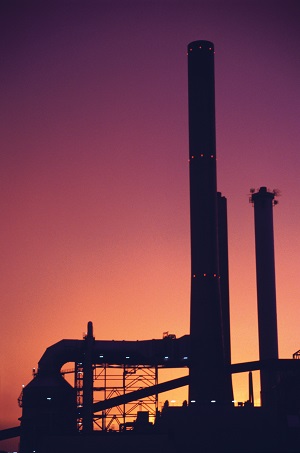
Most of the information provided in our publications and at this site applies to the process industries overall - it is not industry specific. Procedures for vessel entry, say, are applicable generally. But each industry does have its own special issues and concerns. Therefore it is useful to understand the key features of the various industries and what differentiates them from one another.
The industries covered are:
Activities to do with the exploration and production of oil and gas, both onshore and offshore, are generally referred to as Upstream. The processing of the oil and gas in refineries and the manufacture of chemicals and petrochemicals are Downstream operations. The pipelines which connect the two are often referred to as Midstream. Transportation of chemicals by truck, train and barge is also included in the midstream category, as are some gas processing operations.
The following two sketches, both of which are published by the U.S. Department of Transportation at their Pipeline & Hazardous Materials Safety Administration, show the flow of oil and gas and the uses to which these materials are put. The first is to do with the distribution of oil from the wellhead to the final user.
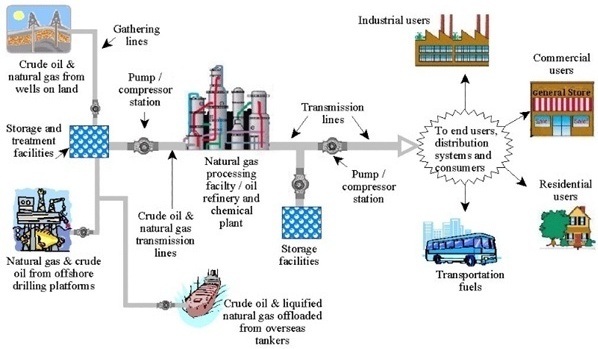
Oil distribution system
The sketch provides the following information.
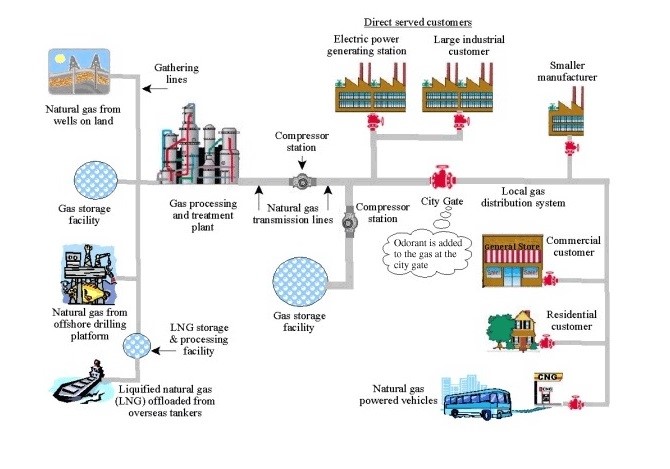
Gas distribution system
The second sketch is to do with the distribution of natural gas from the wellhead to the final user. The gas comes from offshore and onshore wells. It is compressed and sent to gas processing facilities that remove undesirable components such as hydrogen sulfide (H2S).
Some of the articles, safety moments and other publications to do with safety in different industries are listed below.
Copyright © Ian Sutton. 2018. All Rights Reserved.
This Safety Moment has been updated. It is now The Process Safety Professional. Part 9: That Sinking Feeling.
The Primer Distillation is priced at $25 (U.S.) It can be purchased here.
In Safety Moment #8: “But We’re Different, You Know” we show that risk analysis techniques have much in common across different parts of the process and energy industries. Lessons can be shared across industries such as oil refining, chemicals manufacture, pipeline operations and offshore oil and gas production.
This post is the third in a series in which we consider how our approach to industrial safety, and process safety in particular, may change in response to the COVID-19 pandemic. It is early days — no one knows what the ultimate health and economic effects of this frightening event will be. But it seems likely that we are entering a ‘New Normal’. So much has happened so quickly that it is hard to visualize how we can return to the ‘Old Normal’. All of us wish for a quick, V-shaped recession, after which the economy comes roaring back, more vibrant than ever.
If you fly over the offshore platform of the future in a helicopter and look down you will see just two living beings: an operator and a dog. The operator’s job is to feed the dog; the dog’s job is to make sure that the operator doesn’t touch anything.
This is the third post in the series ‘The Shape of Net Zero’.
The good old days
This post is the second in the series ‘The Shape of Net Zero’. The series is based on an understanding that we cannot simply switch out one source of energy (fossil fuels) with another (wind, solar, nuclear and others) and carry on with Business as Usual. We need to consider the following parameters to do with a switch in the basics of our energy supply.
A theme of the posts at this site is that we are awash in good ideas, but many of these good ideas cannot be scaled up quickly enough to have a meaningful impact on the climate crisis. This post — Realities: Nuclear Power — illustrates this conundrum. Nuclear power is an established energy source. It has its detractors, but it is established and known to work.
The Deepwater Horizon/Macondo catastrophe in the Gulf of Mexico (GoM) in the year 2010 demonstrated the need for new safety management regulations. The draft regulations went through various iterations, and the name of the responsible government agency changed twice. In the end, the SEMS (Safety and Environmental Management System) regulation became a requirement for offshore oil and gas operations in the United States.