Safety Moment #56: Sinking Standards / Accountants Rule the Waves
This Safety Moment has been updated. It is now The Process Safety Professional. Part 9: That Sinking Feeling.
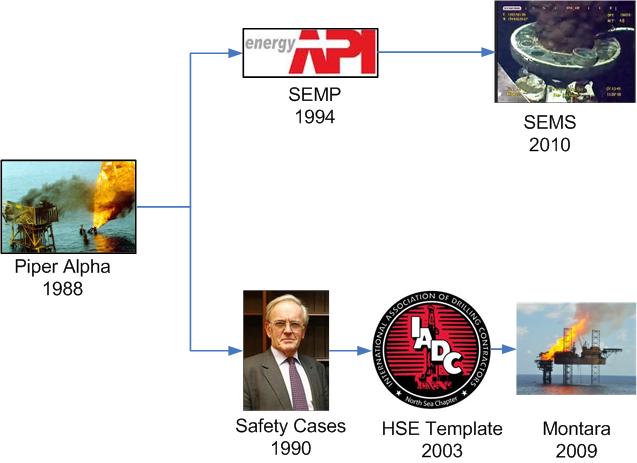
The development of formal safety management systems in the offshore oil and gas industry can be said to have started with the Piper Alpha catastrophe that occurred in 1988. Of course, companies working offshore had had safety programs before that time, but Piper Alpha can be viewed as being the starting point for the development of formal Safety Management Systems for offshore operations — world wide.
Following the accident, an investigation was conducted by a committee headed by the Scottish High Court judge, Lord Cullen. The committee’s report was highly critical of the safety programs that had been in place in North Sea facilities prior to the accident.
In response to the Cullen report the offshore industry took two different tracks, as illustrated in the drawing at the top of this page. Companies operating in the North Sea (and, later on, other areas of the world such as Australia) continued with the safety case approach, as shown in the bottom track of the sketch, but radically improved the thoroughness and quality of the documents and put in place more stringent measures to ensure that the recommended measures were actually implemented.
In the United States (principally the Gulf of Mexico) the response to the Piper Alpha incident was equally vigorous, but followed a different path. The American Petroleum Institute (API) developed their Recommended Practice 75 which recommended that offshore facilities develop a Safety and Environmental Program (SEMP). Like a safety case, RP 75 is non-prescriptive. However, it makes extensive reference to industry standards (mostly from the American Petroleum Institute), and so is perceived as being considerably more prescriptive then the safety case approach. Nor does RP 75 require that a formal assessment of acceptable risk (ALARP) be determined.
Articles and safety moments to do with the offshore oil and gas business are shown below.
Copyright © Ian Sutton. 2018. All Rights Reserved.
This Safety Moment has been updated. It is now The Process Safety Professional. Part 9: That Sinking Feeling.
This post is the third in a series in which we consider how our approach to industrial safety, and process safety in particular, may change in response to the COVID-19 pandemic. It is early days — no one knows what the ultimate health and economic effects of this frightening event will be. But it seems likely that we are entering a ‘New Normal’. So much has happened so quickly that it is hard to visualize how we can return to the ‘Old Normal’. All of us wish for a quick, V-shaped recession, after which the economy comes roaring back, more vibrant than ever.
If you fly over the offshore platform of the future in a helicopter and look down you will see just two living beings: an operator and a dog. The operator’s job is to feed the dog; the dog’s job is to make sure that the operator doesn’t touch anything.
The Deepwater Horizon/Macondo catastrophe in the Gulf of Mexico (GoM) in the year 2010 demonstrated the need for new safety management regulations. The draft regulations went through various iterations, and the name of the responsible government agency changed twice. In the end, the SEMS (Safety and Environmental Management System) regulation became a requirement for offshore oil and gas operations in the United States.
As part of its Well Control Rule BSEE appears to have made a major change in the manner in which offshore risk is to be managed. Section 250.107(a)(3) states,
[y]ou must protect health, safety, property and the environment by utilizing recognized engineering practices that reduce risks to the lowest level practicable when conducting design, fabrication, installation, operation, inspection, repair, and maintenance activities.
This article from the online journal The Hill makes some pointed criticisms to do with BSEE’s rolling back of regulations that were introduced following the Deepwater Horizon/Macondo explosion and fire. It states,